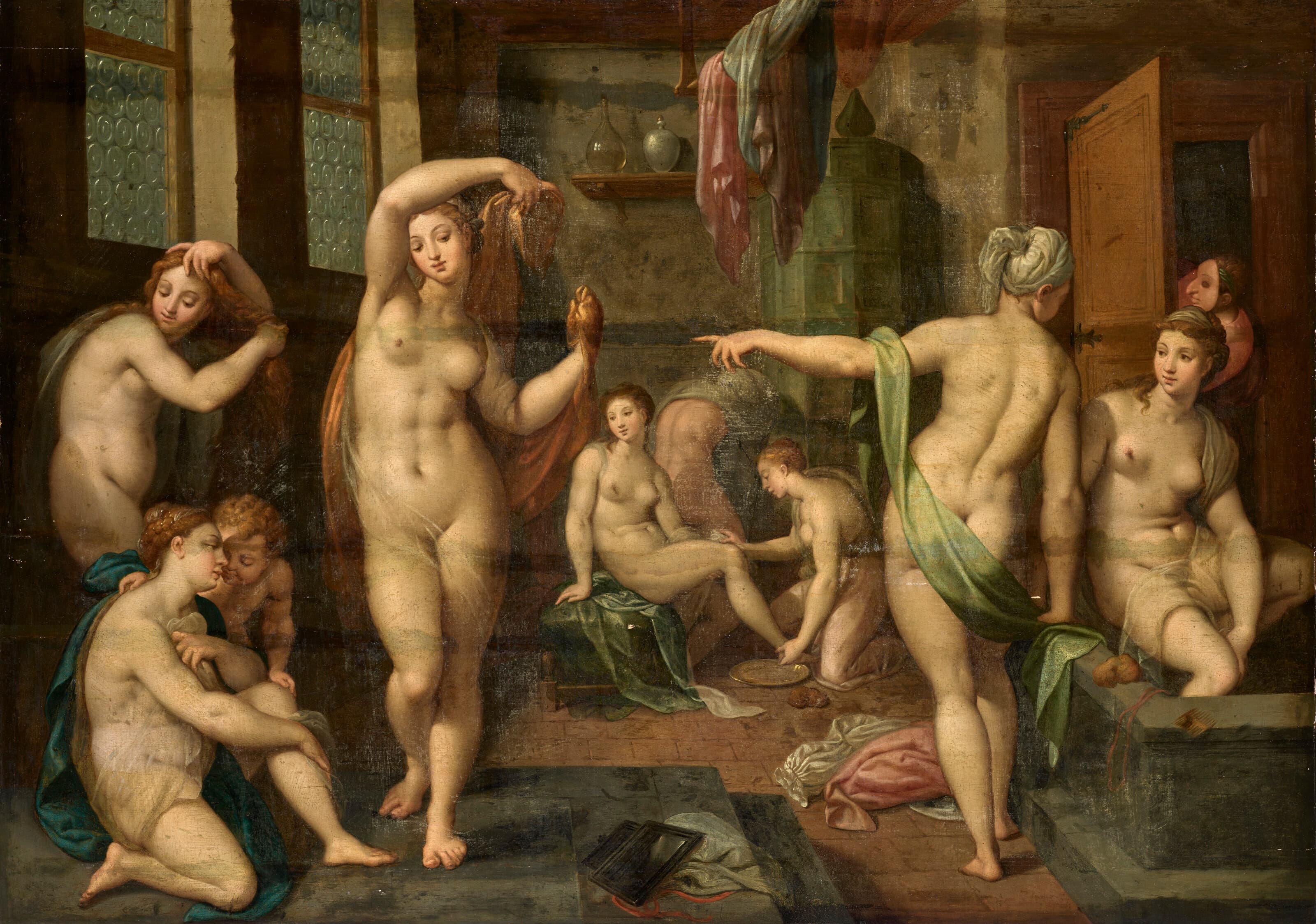
ECOLE DE FONTAINEBLEAU, VERS 1600
Jeunes femmes au bain
A wide, shallow rectangle holds a group of young women at their bath. The scale of the panel—75 by 106 centimetres—encourages the eye to move laterally across the scene rather than settle on a single figure, and the composition rewards that movement: the bathers are distributed across the foreground in poses that recall antique statuary, each body turned or inclined in a different direction. Behind them, the painter has placed glazed ceramic tiles of the kind used in sixteenth-century bath chambers, set with small windows of blown glass known as "à boudines." These are details of contemporary domestic architecture, not antiquarian reconstruction, and their presence shifts the register of the image: the setting is neither a mythological grove nor a purely imagined antiquity but a room that could have existed.
The subject itself belongs to a well-established Fontainebleau tradition. Christie's catalogue note connects the theme of the bath to paintings of royal mistresses half-submerged in large tubs, citing the Louvre's Gabrielle d'Estrées et une de ses sœurs as a point of reference. Water, in this reading, carries associations with fertility and the preservation of youth, while the nymphs who inhabit such scenes—daughters of water deities, charged with protecting gods and raising heroes—supply a classical frame for what is also a distinctly contemporary form of intimacy. The present composition sits at the intersection of these registers, mixing modern fixtures with poses drawn from antique sculpture.
The catalogue note traces the composition to a drawing in the Louvre, once attributed to Primaticcio, later to Rottenhammer, and now classified as Fontainebleau School; a recent hypothesis proposes a Prague School artist instead. That instability of attribution is itself instructive. It points to the traffic of artists and motifs across European courts in the period, and to the way a single composition could migrate: a copper by Jan Brueghel the Elder and van Balen reuses the central figures within a landscape, and a panel associated with Jacob de Backer's workshop adapts the female figures into a more Brueghelian setting. The present painting, acquired at Hôtel Drouot in 2013, belongs to that wider family of images—less a fixed original than a node in a network of repetitions and variations, its authorship still unsettled, its subject still legible.
Details: Dimensions: 75 x 106 cm (29 ½ x 41 ¾ in.) Lot: 7 Auction: Christie's Estimate: EUR 60,000 – EUR 100,000
Provenance:
- Vente anonyme, Ferri & Associés, hôtel Drouot, Paris, 4 décembre 2013, lot 52 ;
- Acquis au cours de cette dernière par l'actuel propriétaire.